A First Visit to an Unfamiliar City Court
A first visit to an unfamiliar city court feels easier when you read its surfaces, shared markings and rhythms before deciding whether to join in.
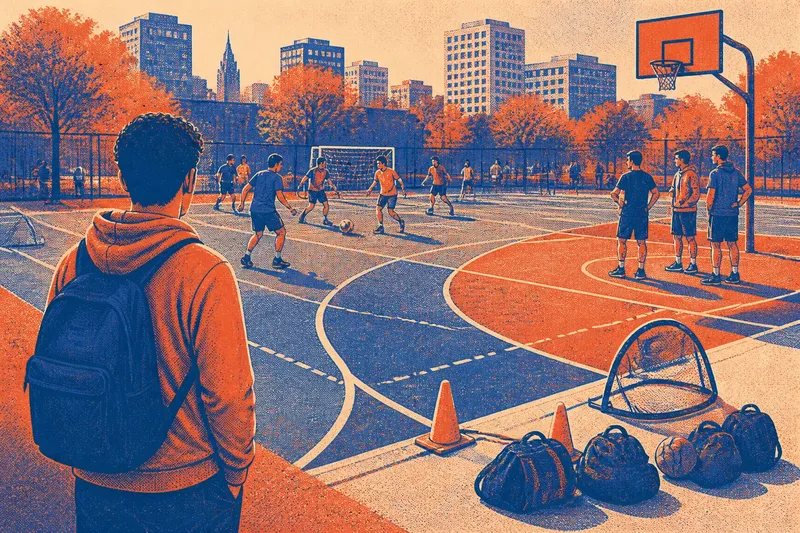
An unfamiliar city court is easier to join when you understand how its playing areas are being used. Before choosing a game, notice the markings, equipment and shifts between activities. The paint may suggest one arrangement; the people using the space can show another.
You do not need to know every local custom. A few quiet minutes can help you decide whether to ask about joining, wait for a pause or simply watch. The aim is to make a clear choice, not to turn the court into a puzzle with a perfect answer.
Read the markings as a starting point
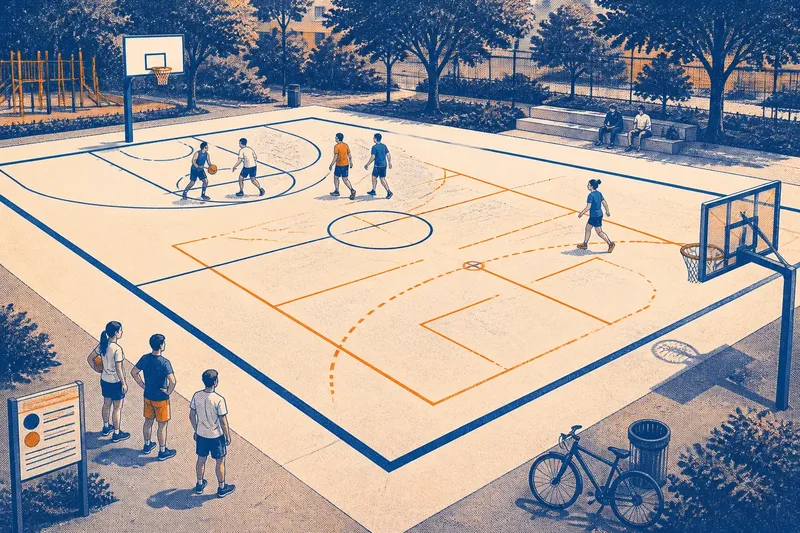
Painted lines identify possible playing areas, but they do not necessarily explain how people share them. A basketball key may sit inside a larger court used for football, while temporary cones or portable goals can divide a surface for a particular session. Treat markings as clues, then check how the space is being used.
Look at where players stand during pauses and where equipment is placed. A clear patch of ground may be a warm-up area or a route between activities rather than spare playing space. If a ball rolls into another group’s area, notice whether its players stop, retrieve it and resume, or wait for a gap. That gives you a better sense of how the boundary works in practice.
Notice when activities change over
A court can change character as one game ends and another begins. Watch for players putting equipment away, moving to a different marked area or inviting others into the next round. These changes can reveal whether people share the whole surface, take turns or keep separate activities apart.
Do not assume that a brief lull means the court is free. Players may be collecting a ball or changing sides before continuing. If a group remains close to a playing area, wait for a clearer pause or ask whether that space is available.
Say you arrive while a football group uses the central area and a basketball hoop stands at the far end. You see a ball cross the painted line, and the football players pause while someone retrieves it. You ask a player at the edge whether the hoop area is shared, and they explain that it is being used later by their group. The result is a clear choice: watch for now, ask again when they finish, or look for another court.
Choose an approach that fits the activity
There is no single correct way to enter an unfamiliar sporting space. Watching, asking or waiting each suits a different situation. Choose the option that respects the game already under way.
Watch when the arrangement is unclear
Observation helps when several activities overlap or players are changing sides. Stand where you can see the markings without occupying a playing area, then notice which lines and objects people actually use. Leave if your chosen spot becomes part of the game.
Ask during a natural pause
A short question is useful when you can identify the people using the space. Ask someone at the edge whether a particular area is free or whether the group plans to use it. Keep the question specific, and accept the answer without pressing for an exception.
Wait when a changeover is under way
Waiting suits a court where players are packing away or preparing a new activity. Stay clear of equipment and let the transition finish before approaching. If nobody indicates that the area is available, ask rather than treating silence as permission.
Check the space before choosing what to do
If painted lines overlap, check which lines players are following; if two activities use different markings, ask before crossing between them, otherwise stay outside the active area.
If portable goals or cones divide the court, check who placed them and which side they are using; if the boundary is unclear, ask the group, otherwise keep to the visibly separate area.
If a ball regularly crosses into another activity, check how players handle retrieval; if they pause play, wait for that signal before crossing, otherwise ask before entering the other group’s space.
If equipment is gathered beside an apparently empty patch, check whether players return to it; if they do, leave the patch clear, otherwise ask whether it is available.
If a group is changing sides or collecting equipment, check whether play has actually ended; if players resume, continue observing, otherwise ask whether the surface is open.
If nobody is using a marked area, check whether another group is waiting for it; if someone is waiting, leave room for them, otherwise ask before starting an activity there.
What should you do when the layout is confusing?
Can an empty marked area still be in use?
Yes: players may be between turns or preparing equipment. Watch for a moment, then ask someone using the court if the area is available.
Should you cross another group’s playing area?
Do not cross during active play. Wait for a pause or ask someone at the edge which route is clear.
How do you tell whether equipment marks a boundary?
Notice whether players keep their activity to one side of the cones, goals or bags. If the boundary is not clear, ask before moving or playing there.
When is it better to try another court?
Choose another court if the activities overlap so closely that you cannot find a clear place to wait or ask. Returning later is more sensible than forcing your way into an uncertain arrangement.
Make participation a choice, not an assumption
Before you leave, decide what would make the visit worthwhile: understanding how the court is shared, asking about a later turn or joining if someone offers a clear opening. That keeps participation from becoming the only measure of success.
At an unfamiliar city court, the markings, equipment and changeovers can help you choose what to do, but they cannot settle every question. Ask when the arrangement remains unclear, and respect a direct answer. Trying to infer every local rule from the paint is not worth the effort; the paint has other duties.