Open Court or Enclosed Cage: How Boundaries Shape Play
Compare an open court with an enclosed cage to choose a boundary that suits the activity, contains stray balls and leaves nearby routes usable.
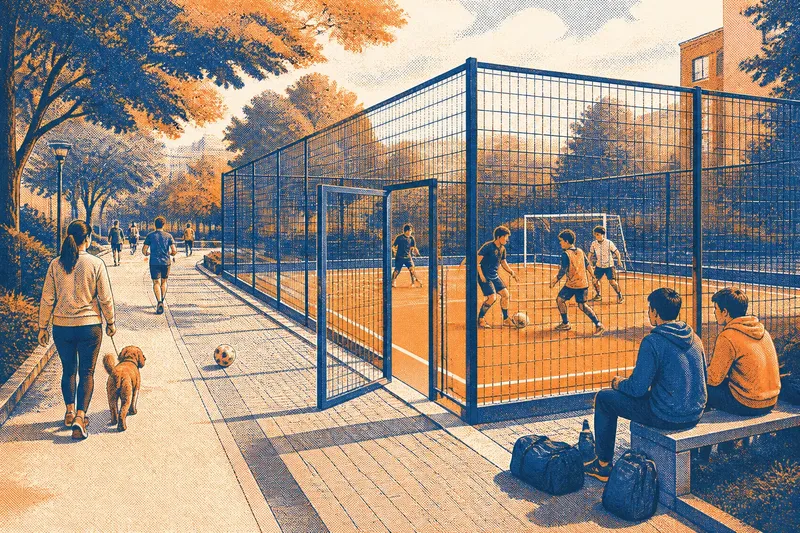
An open court or enclosed cage changes where a game can travel and how nearby people share the ground. The difference is not simply whether a ball stays in bounds: each boundary shapes the usable space around play, from a paved apron to a path beside the court.
Open courts make surrounding ground part of play
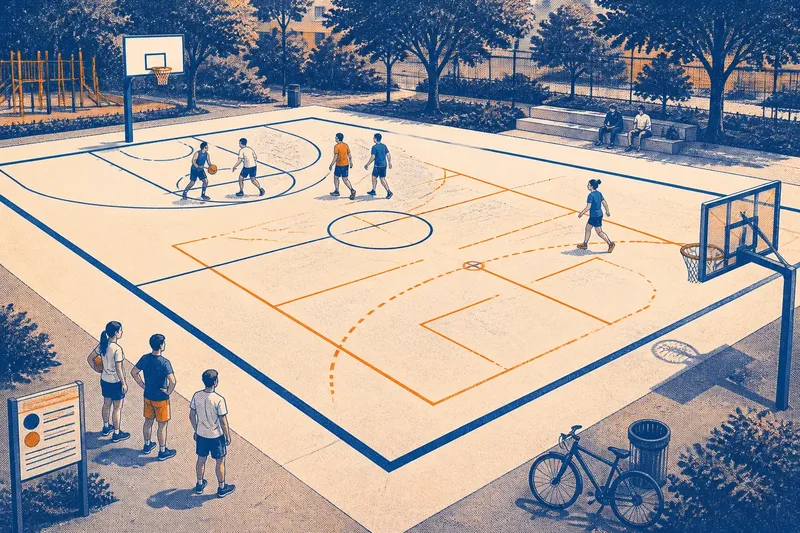
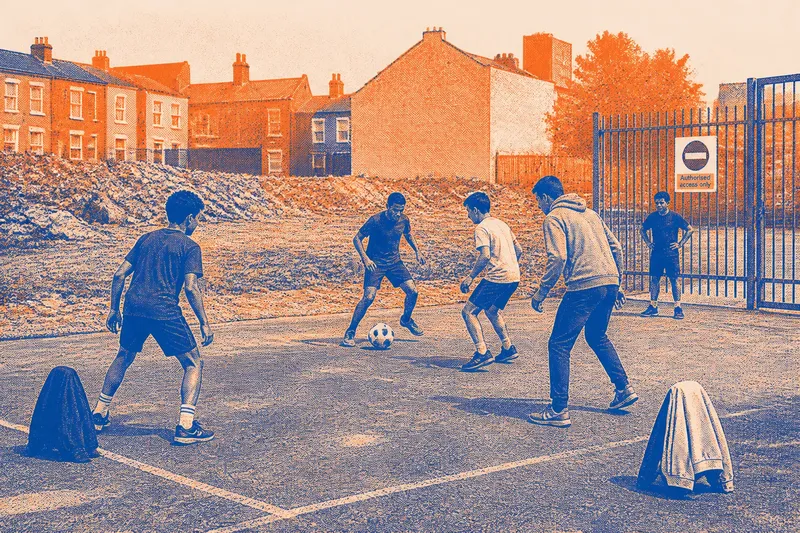
On an open court, painted lines or a change in surface mark the playing area, but the action can spill beyond them. A ball may roll towards a bench, a player may run wide, and someone retrieving the ball must account for other people using the surrounding space.
This arrangement can suit activities that change as players arrive. A half-court beside a broad paved area might support shooting practice, then a loose passing game, while the spare paving gives players room to warm up. That flexibility disappears if the same ground is a busy route or the only clear space for people passing through.
An open edge also gives a site a softer boundary. There is no fence to define the limits of play, so the court can feel connected to a plaza or park. The trade-off is that the designer must make the relationship between play and other uses clear through layout, surface changes, seating and the position of paths.
Enclosed cages make the playing area more distinct
A cage gives the game a visible perimeter. Fencing can contain many ordinary rebounds and keep play from drifting directly into a footpath. The enclosure also makes the playing area legible from a distance, though a gate and fence line affect how people circulate around it.
For activities that use the boundary, a fence can become part of the game. In small-sided football, a ball rebounding from the side may keep play moving rather than sending someone to retrieve it. The same close boundary can make the interior feel crowded when several players move at once.
Enclosure does not resolve every conflict. Balls can still leave through an open gate or over a barrier, and fencing can restrict routes around the court. For a proposed facility, check the activity, likely ball paths, nearby circulation and applicable local requirements with an appropriate designer or authority; do not treat a sketch as a substitute for safety or access advice.
Open court or enclosed cage depends on the boundary problem
Start with the conflict the site needs to address. If play is being interrupted by stray balls, containment may help. If the main difficulty is that a path cuts through the space beside the court, moving or separating the route may do more than adding a fence.
- Check whether balls regularly reach a path; if they do, consider a cage or a revised court orientation, and if they do not, keep the edge open unless another need justifies enclosure.
- Check whether people must cross the playing area to reach a destination; if they must, reroute the path or separate it from play, and if they do not, retain the layout while monitoring crossing points.
- Check whether the activity uses rebounds from a boundary; if it does, choose an enclosure designed for that kind of play, and if it does not, avoid adding a fence that narrows the usable area without a clear purpose.
- Check whether players and spectators have room to wait outside the active area; if they do, mark or furnish that space, and if they do not, revise the layout before adding a gate that could become a bottleneck.
- Check whether planting, seating or other fixed features leave enough clear ground around an open court; if they do, preserve that apron, and if they do not, move or reconfigure the features rather than assuming the court is flexible.
- Check whether the proposed fence and gates meet local access and safety requirements; if they do, proceed with the reviewed design, and if they do not, obtain professional advice and revise it before construction.
Say a neighbourhood is considering a small-sided football cage beside a park path. The starting conditions are a ball that often reaches the path, a gate that would open towards the walking route, and a paved strip available on the far side of the court. The design team first maps the path and likely ball movement, then compares rotating the court with adding a fence. It places the gate towards the paved strip, preserves that strip for waiting players, and checks the revised layout against local access and safety requirements. The expected observable result is that ordinary rebounds are less likely to interrupt path users and waiting players no longer stand in the route; the trade-off is a more contained playing area with less room for play to spread.
Choose the setting around activity and neighbouring uses
An open court can accommodate changing arrangements when the surrounding ground is genuinely available. A cage can give a ball a clearer boundary and help distinguish play from nearby movement, but its dimensions and entrances may favour some activities over others. Neither form is inherently more flexible; the surrounding layout decides much of that.
Consider homes, paths, seating and other active spaces together. A court beside windows may need a different orientation from one beside a broad park lawn. A cage may need a waiting area outside its gate, while an open court may need a clear apron so retrieval and warm-ups do not obstruct a through-route.
What is not worth the effort is adding fencing solely to make a court look orderly when the actual problem is a badly placed path or nowhere for players to wait. Equally, calling a surface open does not make it generous if every loose ball sends someone into a busy route.
What should a court layout answer?
Which setting suits casual drop-in play?
An open court can be easy to share when the activity is visible and the surrounding ground has room for waiting and circulation. A cage can also support drop-in use if its access and rules are clear, but the enclosure makes the boundary more formal.
Will a cage keep every ball away from a path?
No. A ball can leave through a gate or over a barrier, depending on the design and activity. The path’s location and the direction of play still matter.
Can an open court host different activities?
It can, provided the surface and adjoining space let groups use separate areas without crossing through one another’s play. A narrow walkway or fixed furniture can limit that flexibility even when no fence is present.
What should a designer assess before choosing?
Map likely ball paths, pedestrian routes, waiting areas and the clear space around the active surface. Then compare an open edge with an enclosure against the specific conflict each option is meant to address.
Make the boundary serve the wider site
For an open court or enclosed cage, the useful decision begins with the neighbouring ground, not the appearance of the fence. Identify who moves through the site, where play can spread and where people can wait without obstructing anyone else.
A good boundary gives players enough room to use the court while keeping the rest of the site legible and usable. Sometimes that means enclosing the game. Sometimes it means leaving the edge open and moving the path instead.