How Empty Lots Became Neighbourhood Pitches
How empty lots became neighbourhood pitches, and what their temporary use can teach planners about accessible play, changing land use and better replacement spaces.
An empty lot can become a neighbourhood pitch without ever becoming a public space. The phrase “how empty lots became neighbourhood pitches” describes a possible pattern of informal use, not a claim that every vacant site was open or safe. A cleared plot near homes might offer a place to play while it awaits its next use; its ownership and condition still matter.
The pattern is easiest to understand through a specific, illustrative setting rather than a universal history: imagine a dense street where a cleared parcel sits between demolition and construction. If residents use a visible, suitable patch for a casual game, that patch may take on the role of a pitch for as long as access and conditions allow. When work begins or entry is restricted, the opportunity can end.
Vacant land offered a temporary opening, not public access
In a hypothetical neighbourhood, a cleared parcel might be closer than a formal park and large enough for an improvised game. That makes it a plausible place for play, not proof that residents used it or had permission to enter. The account here is illustrative; it does not assign the pattern to a particular city, period or community.
A site can look unused while still having an owner, a planned purpose or restrictions on entry. A delay between demolition and construction does not make that land ownerless. Before anyone considers entering a real site, they need to establish whether access is permitted; if that is unclear, the sensible decision is not to enter.
A neighbourhood pitch took its shape from use
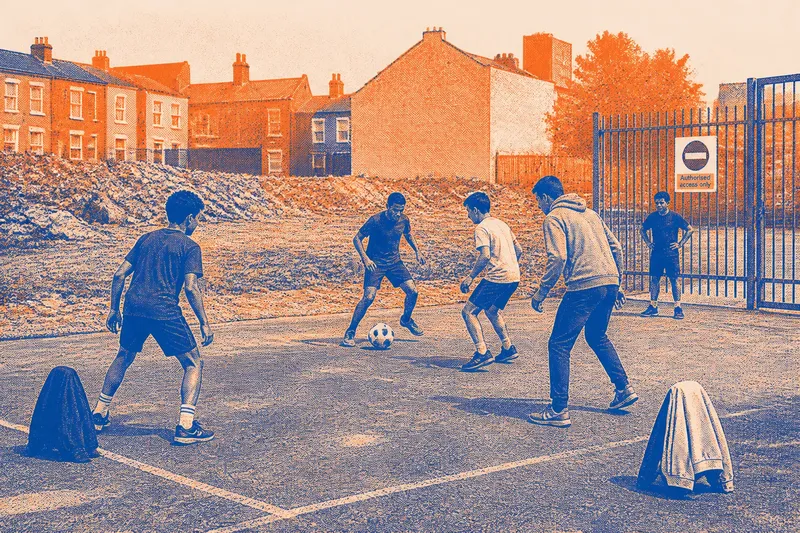
An informal pitch did not need a regulation surface or fixed markings. Players might use a clear patch of paving, compacted ground or grass, then choose boundaries and targets to fit. A pair of coats could suggest goals; chalk could mark a line where the surface allowed it.
Those arrangements were provisional. The game could move around an obstacle, stop for a passer-by or change when the group grew smaller. A lot’s usefulness depended on the specific area people could see and use, not on the whole parcel being suitable.
Players adapted the game to visible conditions
Improvisation has limits. Loose rubble, broken surfaces, hidden hazards, traffic at an edge or unclear access can make a site unsuitable. A clear-looking patch does not establish that the ground is safe, and players should not enter restricted land or disturb materials to make a playing area.
Say a group of neighbours arrives at a cleared plot intending to play a small-sided ball game. They can see a smooth, open patch, loose debris beyond it and a gate marked for authorised access only. They do not enter through the gate; instead, they move to a nearby public hard-surface area, reduce the playing space to fit, and use coats as goals. The observable result is a game contained to a permitted, visible area, while the restricted plot remains untouched.
Informal play needs a clear decision about the site
- Check whether access is explicitly permitted; if it is, use only the permitted area, but if permission is absent or unclear, do not enter and find an accessible public space.
- Check the playing patch for visible broken paving or loose debris; if the surface is clear, keep play within that patch, but if hazards are present or cannot be assessed, stop and choose another location.
- Check whether the game would bring players close to moving traffic; if a physical separation keeps play away, keep the boundary there, but if it does not, move to a safer public area.
- Check whether pedestrians need to cross the proposed playing space; if a clear route can remain open, set the game boundary away from it, but if not, choose a different area.
- Check whether the play requires moving objects or clearing ground; if no alteration is needed, leave the site as it is, but if debris or materials would need moving, do not disturb them and relocate.
- Check whether neighbours or site managers have raised an access or disturbance concern; if an agreed arrangement exists, follow its limits, but if concerns remain unresolved, pause play and seek a suitable alternative.
What is not worth the effort is treating an open-looking plot as a hidden sports facility, or trying to make an unsuitable site usable by shifting debris. That confuses temporary openness with permission and turns a simple game into a poor land-management plan.
Why did neighbourhood pitches disappear?
A temporary playing space can end when fencing, storage, construction or another use changes access. The game may also stop because the available patch changes condition or the people who used it move on. Without a specific place and documented account, these are possibilities, not a universal explanation of how such pitches ended.
Formal parks and courts offer different conditions from improvised sites. A maintained court may make boundaries and access clearer, while an informal patch may have been easier to reach for a particular group. A replacement space should therefore be judged by practical access and suitability for the activity, not simply by whether a plan labels it public space.
What do residents ask about empty-lot play?
Did playing on an empty lot make it public?
No. Informal use does not establish ownership, permission or a right to enter. Check the site’s access status; if it is unclear, stay out and use a recognised public space.
How did players mark an informal pitch?
In an illustrative game, players might use coats for goals or chalk for a boundary where that is allowed. They should not leave objects behind or alter a site without permission; if temporary markers are not permitted, play without them or choose another place.
What should happen if a site looks unsafe?
Do not try to clear debris or inspect hidden hazards by entering. If the surface or access cannot be judged from a permitted place, choose another location and, where appropriate, tell the site manager about the concern.
What can planners learn from a lost pitch?
Residents can describe what activity took place, when access was possible and which nearby public spaces could serve as alternatives. That information can help assess a replacement, though a remembered use alone does not settle ownership, safety or planning decisions.
Temporary play can point to a practical planning question
An illustrative vacant-lot pitch can show how a gap in the built environment might support nearby play, while also showing why access and ground conditions cannot be assumed. The useful planning question is specific: what activity did residents need, who could reach it, and does a proposed alternative support that activity in practice?
When a site changes, a brief account of its use can help keep that question concrete. Note the activity, the part of the space it occupied, any access limits and the nearest suitable alternative. For empty lots that became neighbourhood pitches, the enduring lesson is not that every parcel should stay open; it is that temporary play deserves a clear, grounded answer when a place disappears.